DJI and foreign drone restrictions: What this means for you
In late 2025, new U.S. legislation introduced restrictions on Chinese and certain foreign-made drones, including DJI. These changes mainly affect new drone models entering the U.S. market.
If you already own a DJI or other foreign-made drone, you can continue to buy, own, and operate it under existing FAA/FCC rules—unless you’re flying on federal projects or near sensitive infrastructure.
Let’s explore what’s changed, what hasn’t, and what it means for drone operators, survey teams, and companies who are looking to invest in new platforms.

What you CAN do
You can still buy, own, and operate existing DJI models and other foreign-made drones—so long as you’re not flying on federal projects or near sensitive infrastructure.
- Keep using your current drones: DJI and other foreign-made drones already approved for use in the U.S. can continue to be flown under existing FAA/FCC rules.
- Buy existing drones: Drones that are already on the market and available through U.S. sellers can still be purchased (subject to availability).
- Follow normal FAA rules: Standard FAA Part 107 regulations still apply to all commercial flights.
- Repair and get parts: While DJI no longer offers a DJI Care plan, many repairs and replacement parts are still available through U.S.-based third‑party service providers. Reach out to your Customer Success rep for options.

What you CAN’T do
Restrictions apply to new drone models and certain parts.
- Buy new DJI models: Any DJI drone that hasn’t already been approved for the U.S. cannot be imported or sold unless cleared by the DoD or DHS (Think hypothetical Matrice 500 or Matrice 5E)
- Buy new foreign-made drones: Other non-U.S. drones that haven’t received DOD or Blue List approval also cannot be imported or sold
How this impacts other foreign-made drones
The rules aren’t just about DJI. They affect other foreign-made drones that need FCC approval to be sold or imported in the U.S. Here’s what that means:
- New models may be restricted: If a foreign-made drone hasn’t received FCC authorization in the U.S., it can’t be legally imported or sold
- Some drones could be exempted: The DoD or DHS may grant special approvals for certain drones and parts, but only a few are covered
- Existing drones remain legal: Drones already approved and sold in the U.S. can still be flown and sold so long as you’re not flying on federal projects or near sensitive infrastructure
The bottom line
You can continue flying and purchasing your drones safely, legally, and with confidence.
For a majority of customers, restrictions mainly affect new drone models and imports, not what’s already in use. Stay aware of FCC updates and state level legislation (we’ve put some helpful links below) and check manufacturer guidance for any new models or exemptions.
Seamless drone compatibility for accurate site data
Propeller works with data from any drone. The drones below have been tested and verified to deliver reliable, high-precision photogrammetric models.
| Drones | Platform compatible Works with Propeller for processing and analysis |
PPK-enabled Processes PPK data streams for survey-grade accuracy |
Hardware support Expertly supported by Propeller’s Hardware Support team |
Expected accuracy Based on ideal settings, workflows, and site conditions for your drone |
Supported payloads Compatible sensors and cameras |
Where to Buy |
Federal Restrictions |
|---|---|---|---|---|---|---|---|
| Anzu Raptor | 5-10cm | Model: Raptor | We can source - but are not a dealer | YES | |||
| Autel Evo II Pro RTK V1/V2 | 7-10cm | Model: XT705 | We can source - but are not a dealer | YES | |||
| Autel Evo II Pro RTK V3 | 5-10cm | Model: XL705 | We can source - but are not a dealer | YES | |||
| DJI Matrice 300/350 RTK | 3-5cm | Zenmuse P1 with 35mm lens Zenmuse L1 for photogrammetry + LiDAR Zenmuse L2 for photogrammetry + LiDAR |
Buy from Propeller | YES | |||
| DJI Matrice 400 | 3-5cm | Zenmuse P1 with 35mm lens Zenmuse L2 for photogrammetry + LiDAR |
Buy from Propeller | YES | |||
| DJI Mavic 3 Enterprise | 3-5cm | Model: M3E | Buy from Propeller | YES | |||
| DJI Matrice 4 Enterprise | 3-5cm | Model: M4E | Buy from Propeller | YES | |||
| DJI Phantom 4 RTK | 3-5cm | Model: FC6310R | Buy from Propeller | YES | |||
| Quantum Trinity F90+ | 3-5cm | Sony UMC, Model: UMC-R10C Sony RX1R II, Model DSC-RX1RM2 |
We can source, but not a dealer | NO | |||
| Skydio X10 | 3-7cm | Model: VT300-L_93 V100-L |
Buy from Propeller | YES | |||
| WingtraOne Gen I / Gen II | 3-5cm | Map61 RGB61 Sony a6100 Sony RX1R II, Model: DSC-RX1RM2 |
We can source - but are not a dealer | NO | WingtraRAY | Strict | Map61 | We can source - but are not a dealer | NO |
FAQs
No. These tricky restrictions are specific to U.S. regulations and U.S.-funded projects. If you’re operating outside the United States, your ability to fly, capture data, and use Propeller is totally unchanged.
Short answer: no.
Drone models that were already approved by the FCC. remain legal to buy, sell, and fly. The restriction applies only to future DJI models that haven’t received FCC authorization.
Yes. Your drone will continue to operate normally and remain legal to fly under FAA/FCC rules.
If the model requires FCC equipment authorization and hasn’t been approved for the U.S., it cannot be legally imported without authorization. However, existing authorized models (like the M4E) can still be imported.
Foreign-made brands are subject to the same FCC rules – current Blue List drones are being granted “legacy” status and allowed under previous rules.
If a drone requires FCC authorization and is on the Covered List, new models cannot be sold or imported without exemption. Some models may be exempted by DoD or DHS.
No. Standard FAA rules, including Remote ID and Part 107 requirements, remain unchanged. The restrictions only impact import, sale, and FCC certification.
These restrictions mainly apply to federally funded projects, where federal security and procurement rules are required. That includes work tied to agencies like the Department of Transportation, Department of Defense, or Army Corps of Engineers.
For private, state, or local projects, the rules don’t always apply. That said, some owners and contractors choose to follow the same standards to stay aligned with federal requirements or future funding eligibility.
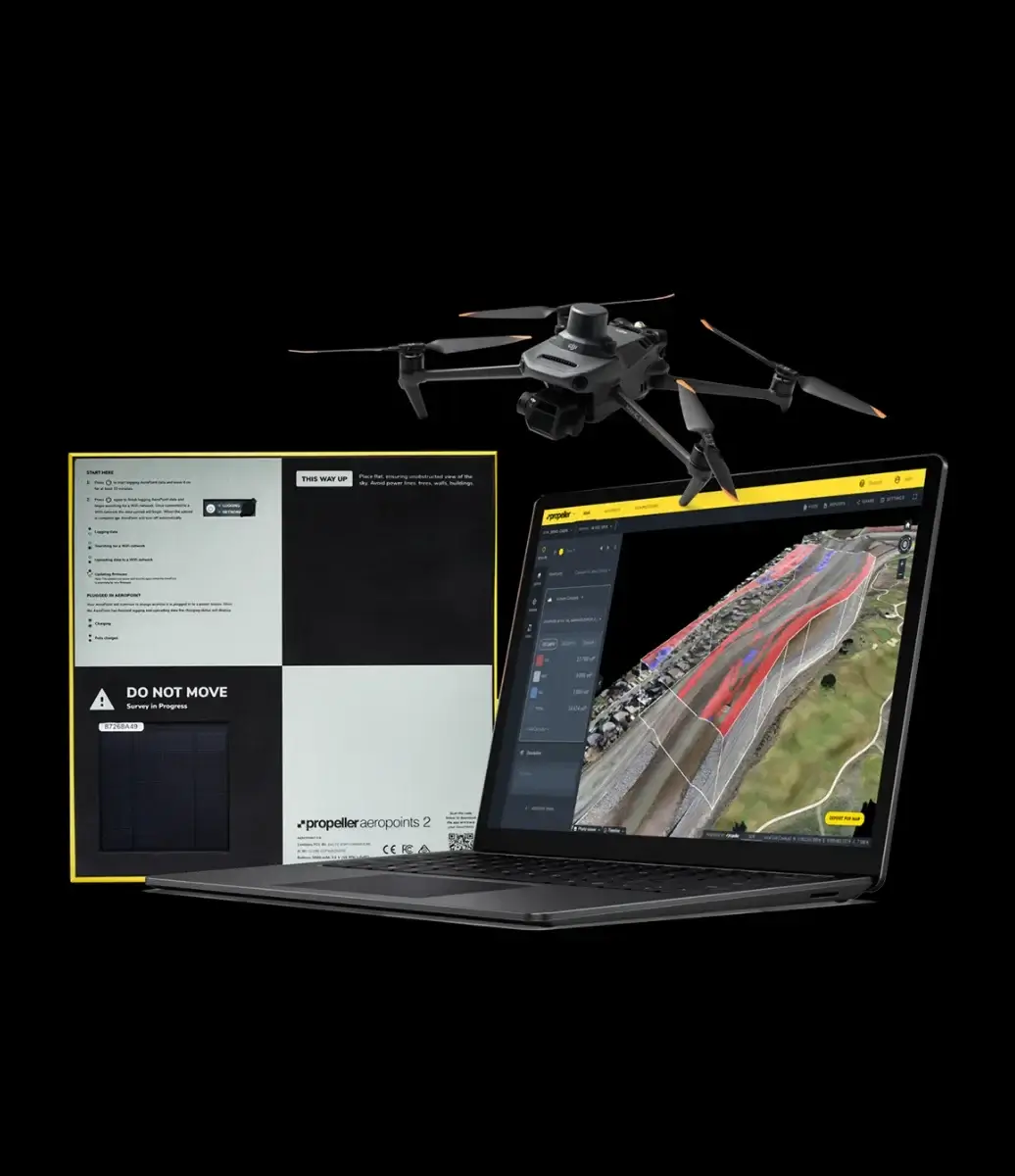
Propeller is still hardware agnostic, so restrictions on a specific drone brand don’t limit what you can do in the platform. If DJI isn’t an option on your project, we’ll help you match with compatible, PPK-enabled drones that meet your site requirements and any owner or agency rules.
Your workflows, accuracy, and outputs in Propeller stay the same. The only thing that changes is the pool of hardware we pull from to get you set up with the right equipment for the job.