How Propeller calculates expected accuracy

Read Time: 5 mins
Quick links

    Learn what a point cloud actually is and then how drone data is integrated with a point cloud to build a 3D worksite model. 
    Accuracy is a critical factor for any kind of site surveying. However, the level of accuracy you need can vary depending on the project. So what does “expected accuracy” mean when we’re talking about drones and sensors, and how can it help you identify the right tools for the job at hand?

    In this article, we’re breaking down the expected accuracy ranges for some of the most reliable survey drones on the market. We’ll show you how we calculate expected accuracy—and what these numbers mean to you—so you can confidently select the right hardware for your next project.

    What is expected accuracy?

    “Expected accuracy” indicates how closely measurements collected by survey hardware, such as a drone, can align with real-world measurements under ideal surveying conditions. It estimates the precision of a terrain model built from that drone’s data compared to verified ground locations.

    For example, if a drone has an expected accuracy of 3-5cm, each point in a 3D terrain model generated from that drone’s data is predicted within 3-5 centimeters of the true locations for those points in the physical environment.

    Expected accuracy is an important metric because it tells you how much you can trust the precision of your survey data. The level of accuracy you need will vary by project. For instance, a civil contractor laying foundations needs extremely precise measurements, whereas a landfill operator may only need approximate figures to estimate a cell’s remaining airspace or compaction rate.

    Expected accuracy for Propeller-compatible drones

    To help you plan confidently and get the most from your survey data, Propeller provides expected accuracy ranges for each drone we’ve tested. These reflect typical outcomes when flying with Propeller PPK workflows and recommended AeroPoints.

    DJI Matrice 400
    Expected accuracy: 3–5 cm
    Recommended AeroPoints: 1* (minimum 1 as PPK base and GCP)

    DJI Mavic 3 Enterprise
    Expected accuracy: 3–5 cm
    Recommended AeroPoints: 1–3*

    DJI Phantom 4 RTK
    Expected accuracy: 3–5 cm
    Recommended AeroPoints: 1–3*

    DJI Matrice 4 Enterprise
    Expected accuracy: 3–5 cm*
    Recommended AeroPoints: 1–3*

    DJI Matrice 300/350 RTK
    Expected accuracy: 3–5 cm
    Recommended AeroPoints: 1–3*

    WingtraOne Gen I / Gen II
    Expected accuracy: 3–5 cm
    Recommended AeroPoints: 3*

    Quantum Trinity F90+
    Expected accuracy: 3–5 cm
    Recommended AeroPoints: 1–3*

    Autel Evo II Pro RTK V1/V2
    Expected accuracy: 7–10 cm
    Recommended AeroPoints: 1–3*

    Autel Evo II Pro RTK V3
    Expected accuracy: 5–10 cm
    Recommended AeroPoints: 1–3*

    Skydio X10
    Expected accuracy: 3–7 cm
    Recommended AeroPoints: 3*

    Anzu Raptor
    Expected accuracy: 5–10 cm
    Recommended AeroPoints: 1–3*

    *1–3 AeroPoints should be used for sites up to 150 acres.
    For each additional 50 acres (20 hectares), 1–2 additional AeroPoints are recommended.

    How Propeller calculates expected accuracy

    Where did these expected accuracy figures come from? As you may have guessed, it all starts with a test flight. 

    To ensure we compare apples to apples, we maintain optimal flight conditions and settings for every drone we test. We fly the same site using the same ground control setup (including AeroPoints) with consistent image overlap and optimized flight altitude based on each drone’s focal length and field of view. We then compare those results against benchmarks from a trusted, high-accuracy PPK drone and known ground control points.

    After the test flight, we make three calculations that determine the final accuracy figure:

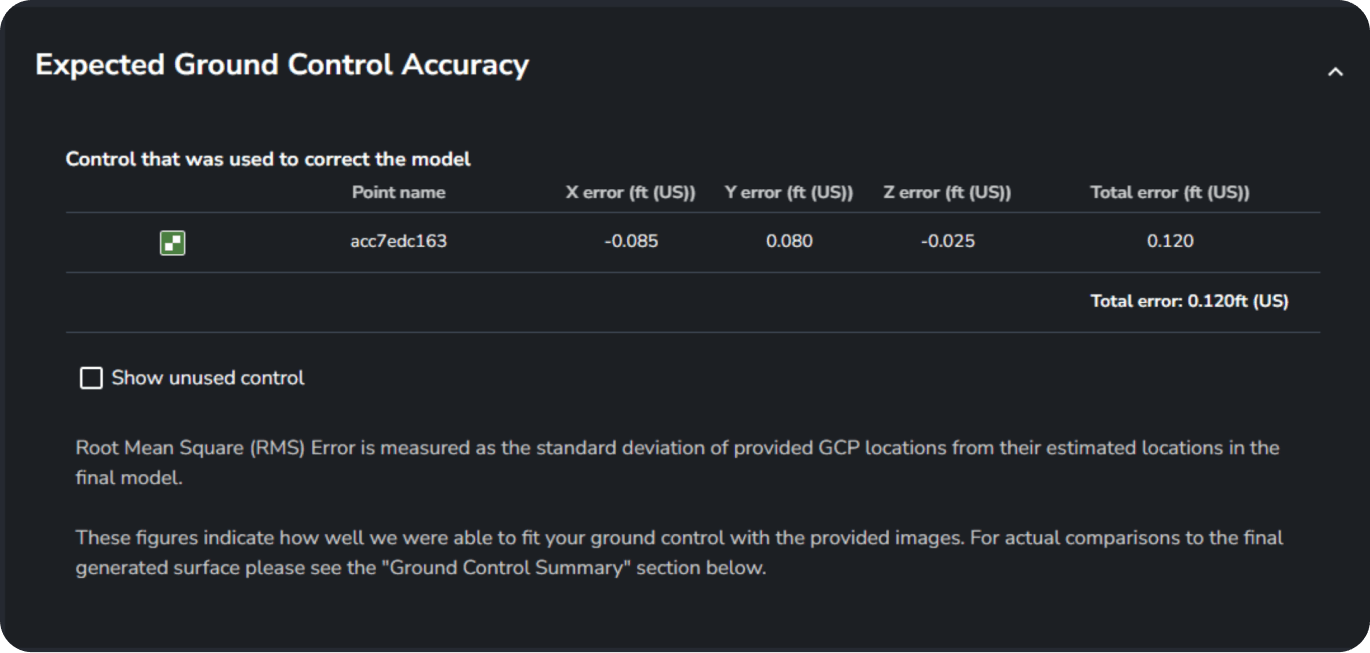
    • Ground Control Points Root Mean Square Error (GCP RMSE)
    • GCP-to-surface difference
    • Elevation model consistency

    Ground control points root mean square error (GCP RMSE)

    This figure represents the average difference between the actual locations of ground control points (GCPs) on-site and their estimated positions in the drone’s output model. The lower the RMSE, the more precisely the drone’s model matches real-world coordinates. 

    GCP RMSE is typically calculated across easting, northing, and elevation to provide a reliable indicator of both horizontal and vertical accuracy. 

    Ground control points root mean square error (GCP RMSE)


    Elevation model consistency

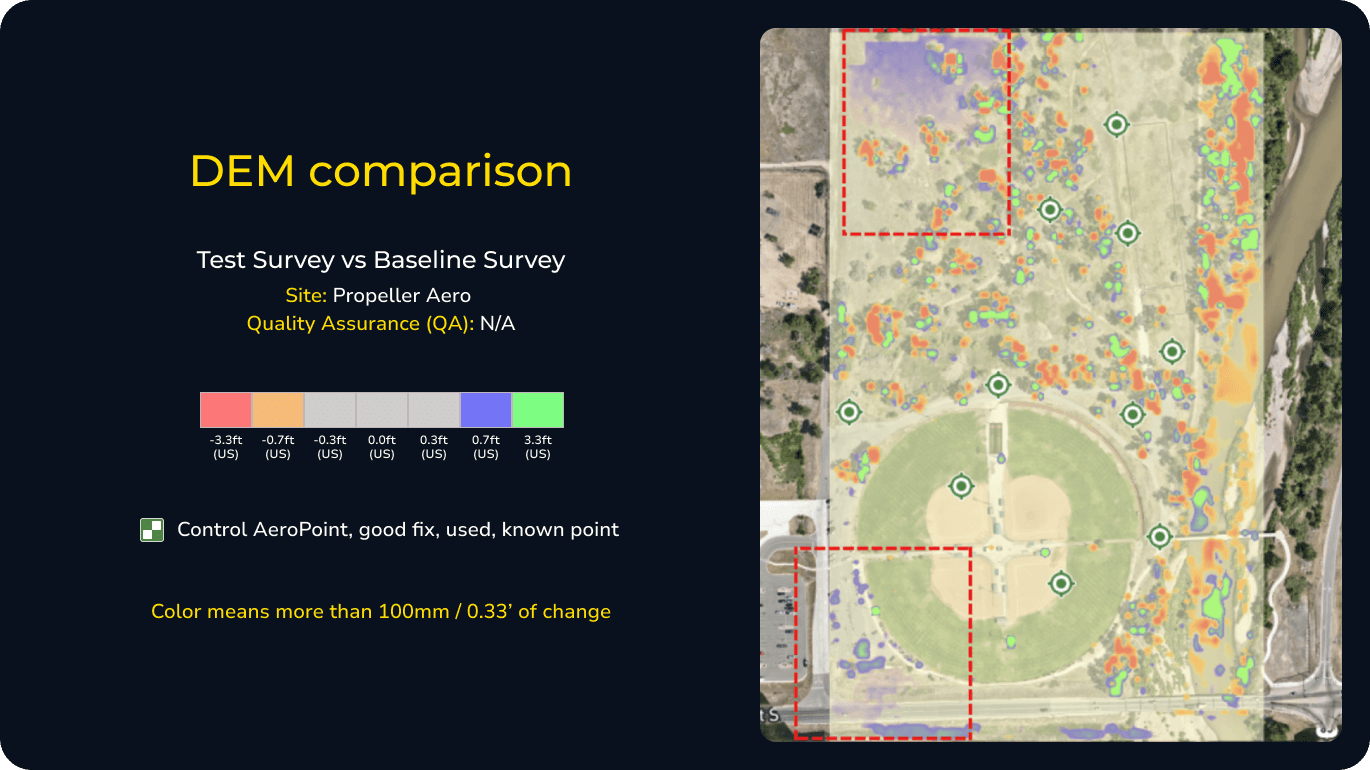
    Finally, we measure a drone’s elevation model consistency by comparing its survey results to a baseline model generated by a trusted, high-accuracy PPK drone. By analyzing the differences in elevation between these two models, we can see whether the tested drone meets our accuracy benchmarks. Consistent results across the same survey area show that a drone can reliably produce survey-grade accuracy.

    Elevation model consistency

    GCP-to-surface difference

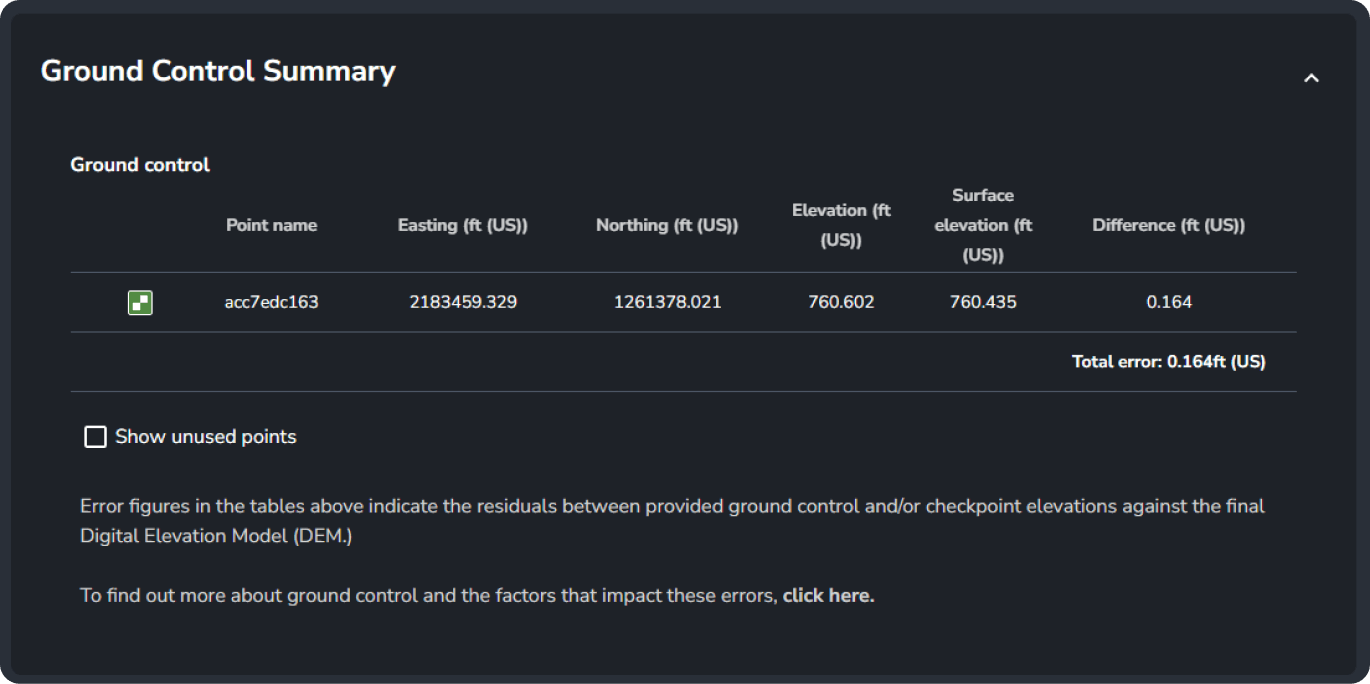
    The GCP-to-surface difference reflects the vertical difference between a GCP’s actual elevation and the corresponding points on a drone’s Digital Elevation Model (DEM). A minimal difference shows that the model closely represents the true ground elevation, which is critical for projects that need accurate surface measurements.

    For example, if a GCP is at a 200-meter elevation on the actual site, but the surface elevation of the same location for that specific point in the processed model shows 198 meters, the two-meter vertical difference would be the GCP-to-surface difference.

    GCP-to-surface difference2

    Generating the final expected accuracy range

    The last step is to assign a single accuracy range based on the data’s consistency:

    • Similar results: If all three measurements yield similar accuracy results (i.e., falling into similar tiers such as 3-5cm), we use this value to represent the expected accuracy for that drone
    • Different results: If the GCP-to-surface difference or elevation model consistency reflects lower accuracy than the other components, we adjust the final value accordingly. For example, the Autel EVO II V3 has a 5+cm difference for elevation model consistency, but the GCP RMSE is within 5cm. Our final expected accuracy figure is 5-10cm, which reflects both the DEM margin of error and the higher accuracy values for GCP RMSE

    How to use expected accuracy ranges

    Site surveys are not created equal, and the level of precision required depends on several factors, including budget, time, and how you’ll use the data. When accuracy is paramount, you need confidence that your drone will provide the best aerial data outputs possible. When time is of the essence, you may just need a quick way to generate rough estimates.

    Understanding expected accuracy helps you decide which piece of survey hardware will do the job most effectively. (Psst: Once you’ve completed your survey, data processing is another critical piece of the accuracy puzzle—read more here.) 

    These ranges are a valuable guide, but if you still need support selecting the best drone for your worksite, we’re here to help! Our global team is available 24/7 to answer your questions and help you achieve your perfect level of accuracy.

    How to use expected accuracy ranges

    Ready to learn how Propeller can power up your worksite with easy and effective data-sharing? Request a demo today.

    Quick links

      Related articles

      Better Blast Planning, Monitoring and Quarry Reporting Using Drone Data

      Making decisions with the most up-to-date and reliable information is critical for any site manager,…
      Six smart ways to use drones in mines and quarries

      The use of drones in mines and quarries is common, but these sites are highly…

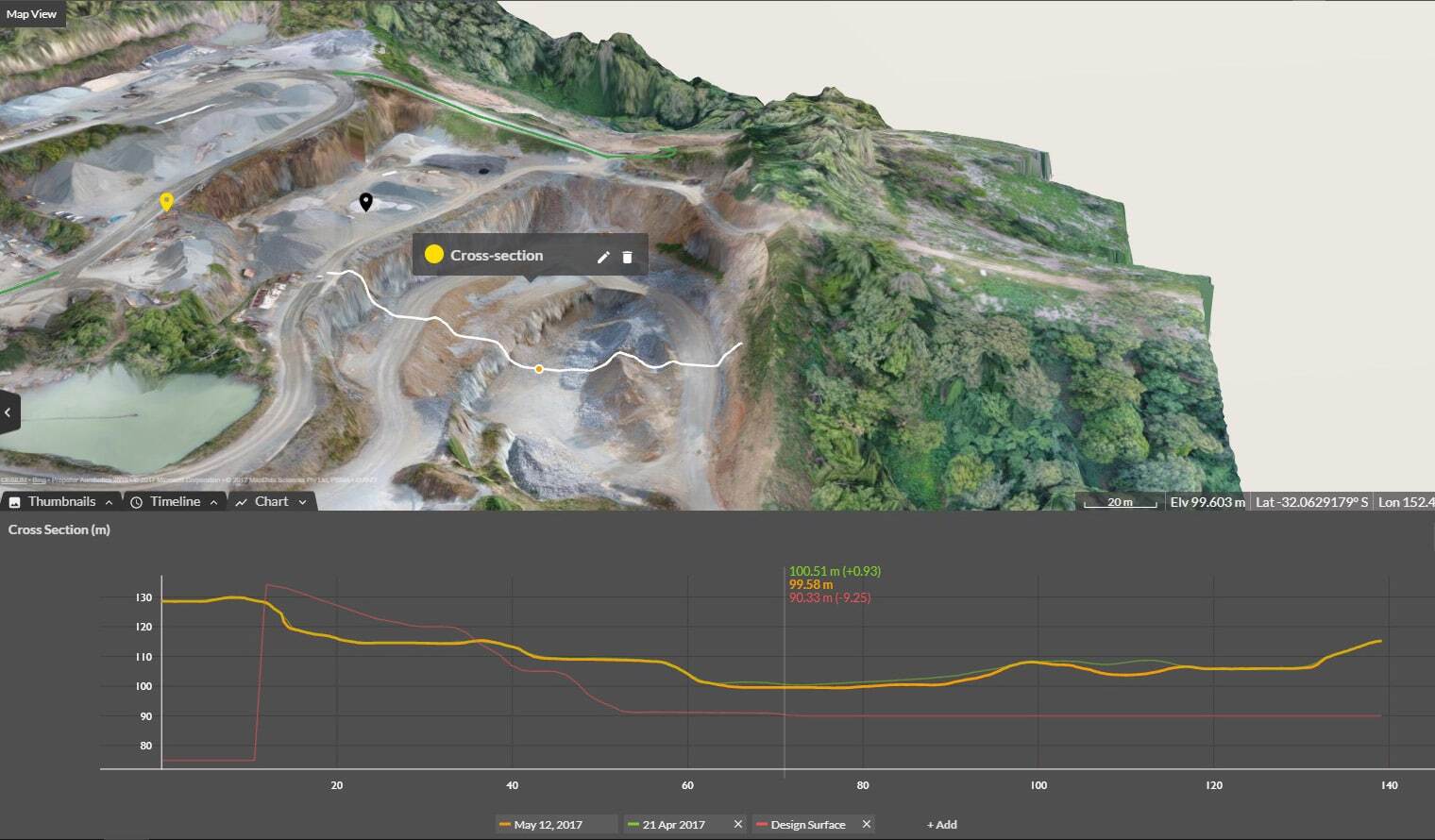
      Cross Section Survey in a Matter of Minutes Using Drone Data

      With the power of drone-captured data and the Propeller Platform, surveying cross sections becomes as…

      Ready to learn how Propeller can power up your worksite?

      We’re happy to show you how Propeller can power your worksite, and boost productivity.

      Related articles

      Drone pilot in hi-vis flying a drone next to a crane, with an AeroPoint on the floor.

      Things To Know About Ground Control in Drone Surveying

      Ground control is the go-to option for turning drone data into highly accurate, survey-grade models.…
      DJI M4E flying in the sky

      Propeller’s Drone Guide: DJI Solutions for Commercial Operations

      At Propeller we love testing new drone hardware and we are processing hundreds of drone…

      Telecom Tower Inspection using DJI Phantom 4 Pro: Step-by-Step Guide

      A few weeks ago a new DJI Phantom 4 Pro was delivered to our office.…